```text
Seedance 2.5, 16:9, 30 seconds.
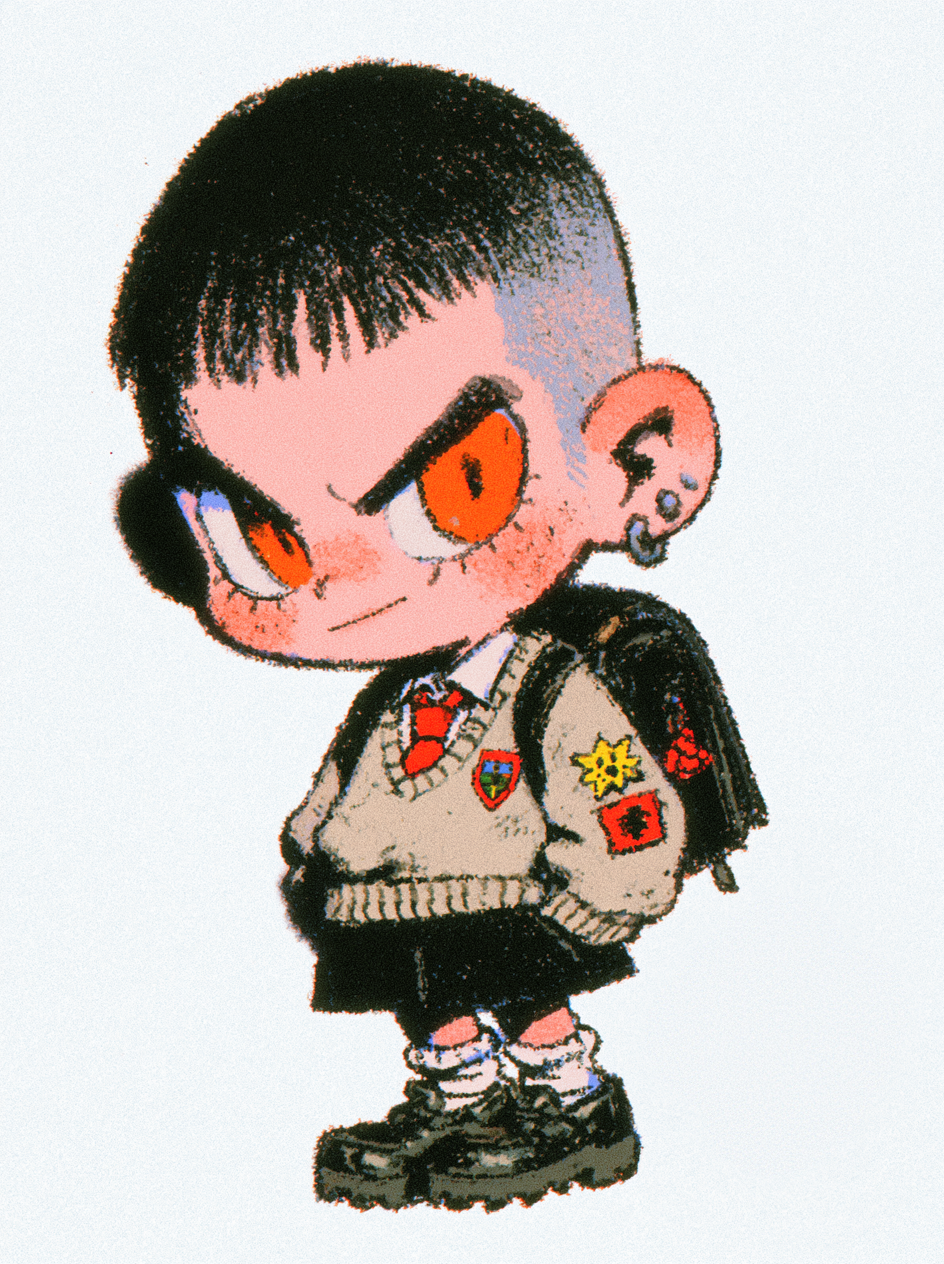
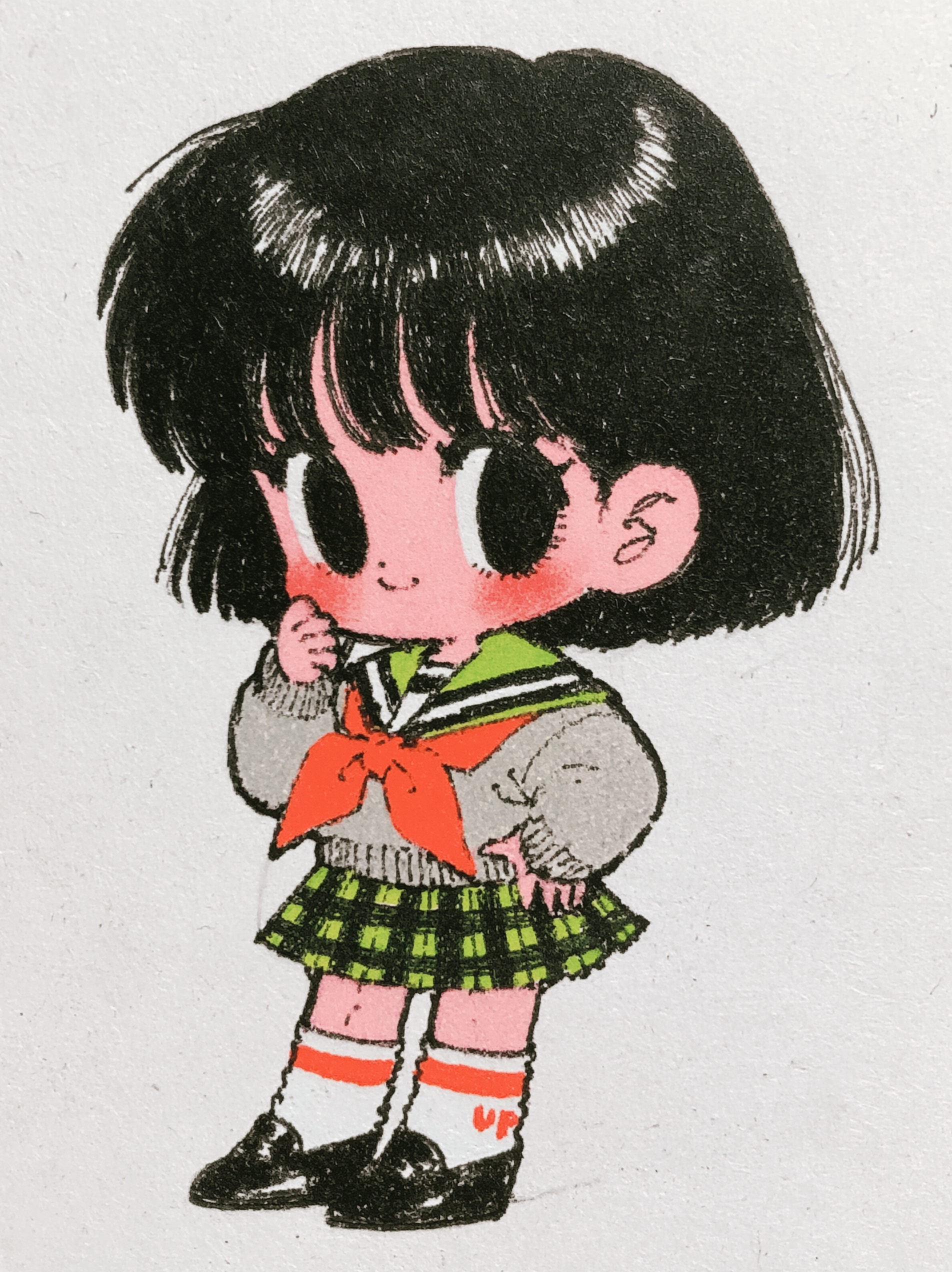
Use both reference images as the two main characters.
Character A: cute black-bob schoolgirl, green plaid skirt, orange scarf, white socks, shy and expressive personality.
Character B: mischievous-looking schoolboy, shaved sides, short dark hair, orange eyes, earrings, sweater with patches, black shorts, backpack.
Preserve both characters’ exact visual identity, facial features, proportions, hairstyles, costumes, colors, retro hand-drawn texture, rough printed paper grain, thick ink outlines, and cute vintage manga illustration style. Do not redesign either character.
Create a quiet but visually engaging school comedy sequence centered on curiosity, misunderstanding, and a cute reveal. The acting should remain relatively restrained, but the camera language should be more cinematic and varied. Use foreground occlusion, low-angle peeking shots, over-the-shoulder framing, top-down compositions, shallow depth of field, rack focus, subtle push-ins, and carefully motivated camera movement.
The cat must be physically present near Character B from the beginning of the alley sequence. Do not make the cat suddenly appear. Initially hide the cat naturally behind Character B’s crouched body and nearby objects so Character A cannot clearly see it. Gradually reveal the cat through camera repositioning and Character B’s movement. The audience should understand that Character B has been feeding the same cat the entire time.
0-4 seconds:
Peaceful school morning.
Start with a low ground-level shot of Character A’s shoes walking along the sidewalk. Morning sunlight creates long soft shadows.
Camera slowly tilts upward as Character A walks toward school.
Use foreground students briefly crossing close to the lens to create depth.
Character A casually looks ahead.
Use a character-locked medium tracking shot as she walks.
Suddenly her eyes shift toward something in the distance.
Cut to an extreme close-up of her eyes.
Eyeline match:
Character B is visible far across the street.
Frame him through passing bicycles, utility poles, or foreground tree branches so he feels partially hidden.
Character B glances left and right, then quietly enters a narrow alley.
Use a slow telephoto push-in on him disappearing behind the corner.
Cut back to Character A.
She stops mid-step.
Small head tilt.
One eyebrow subtly rises.
Hold a short curious reaction beat.
4-8 seconds:
Character A walks toward the alley.
Instead of a flat side view, use a slightly elevated diagonal tracking shot following her between foreground street objects.
As she approaches, camera gradually lowers behind her shoulder.
She slows down.
Her posture becomes cautious.
At the alley entrance, use an over-the-shoulder shot with Character A partially silhouetted in the foreground.
The bright street behind her contrasts with the cooler shaded alley.
Character A carefully leans around the wall.
Cut to a narrow POV framing.
Character B is crouching several meters away with his back turned.
His body blocks most of what is directly in front of him.
Only very small hints suggest another presence:
a tiny tail briefly moving beside his leg,
the edge of one small furry ear,
or a slight shadow shifting near the ground.
Do not clearly reveal the cat yet.
8-12 seconds:
Use a low-angle shot from near ground level behind some stacked boxes or a small alley object.
Character B remains crouched in the midground.
One hand repeatedly moves toward the ground as though placing small pieces of food.
The cat remains mostly hidden behind his knees and backpack.
A tiny paw briefly enters frame near Character B’s hand and disappears again.
Cut to Character A watching from behind the wall.
Rack focus from the edge of the wall in foreground to her curious face.
She leans farther forward.
Use a slight Dutch angle, very subtle, to emphasize her suspicion.
Cut to an overhead three-quarter shot showing the distance between Character A and Character B, while Character B’s body still naturally obscures the cat.
Character A decides to investigate.
12-16 seconds:
Character A quietly enters the alley.
Use a ground-level tracking shot beside her feet as she tiptoes forward.
Foreground pipes, boxes, plants, or fences intermittently slide across the lens to create parallax.
Insert:
her shoe carefully avoiding a small can on the ground.
Insert:
her hand lightly touching the wall.
Cut to a compressed over-the-shoulder shot from directly behind Character B.
Character A appears far in the background, slowly approaching.
Character B remains completely focused downward.
Very subtly show the cat’s tail moving behind his arm.
Cut back to Character A in a medium close-up.
She squints slightly.
Tiny eye dart downward.
She still cannot tell what he is doing.
16-20 seconds:
Character A comes almost directly behind Character B.
Use a high-angle shot looking down at both characters.
Character B’s crouched silhouette continues to hide the cat beneath and slightly in front of him.
Character A leans forward.
Just before she speaks, Character B notices her shadow appearing beside his own on the ground.
Insert shot:
Character B’s eyes widen slightly.
His shoulders stiffen.
He quickly twists around.
Use a fast 90-degree camera arc synchronized with his turn.
One brief anime smear frame during the motion.
Character B sees Character A directly behind him and panics.
His hand jerks upward, sending several small snack pieces into the air.
Use a low-angle shot looking upward through the falling snack pieces.
Character B loses balance and drops backward onto the ground.
Character A becomes equally startled and instinctively steps backward, catches her foot awkwardly, and also lands seated.
Use a wide two-shot with both characters facing each other on opposite sides of the frame.
Brief hit-stop.
Silence.
20-24 seconds:
Do not introduce the cat with a sudden cut.
Instead, keep the same wide composition for a moment.
A small cat calmly walks out from behind Character B’s bent leg into the open space between the two characters.
The cat has clearly been there the entire time.
It immediately approaches one of the snack pieces that fell nearby.
Use a very low ground-level close-up following the cat.
The cat sniffs once, then happily begins eating the scattered snack pieces.
Camera slowly dollies sideways past the cat, revealing Character B still sitting embarrassed in the background.
Rack focus from the cat eating in the foreground to Character B.
Character B is holding the remaining snack packet.
This visually confirms that he was secretly feeding the cat.
Cut to Character A.
Her suspicious expression instantly softens.
24-27 seconds:
Use a point-of-view shot from Character A:
Character B sitting awkwardly,
the open snack packet in his hand,
the cat happily eating between his shoes.
Cut to Character A’s close-up.
She processes the situation.
Tiny blink.
Eye dart to Character B.
Eye dart back to the cat.
A short double take.
Her lips tighten as she tries not to laugh.
Use a very slow push-in.
She finally fails to hold it in and bursts into genuine laughter.
Her shoulders move slightly.
She leans forward with one hand near her mouth.
Use a three-quarter medium shot rather than a flat frontal close-up, with Character B softly visible out of focus behind her.
27-30 seconds:
Use Character B’s POV looking toward Character A laughing.
Character B becomes visibly embarrassed.
Cut to a close three-quarter profile of him.
His eyes look away.
His shoulders sink slightly.
He tries to keep his usual cool expression, but an awkward shy smile appears.
Meanwhile, the cat casually walks closer to Character B and sits beside his leg.
Character B instinctively lowers one hand and gently places another small snack piece in front of the cat.
Character A notices this and smiles even more.
Finish with a visually layered final shot:
cat in the near foreground,
Character B seated slightly behind it trying to look cool,
Character A on the opposite side still smiling.
Use a slow crane-up and subtle pull-back to reveal the full narrow alley surrounded by the brighter morning street beyond.
End on a warm moving hold:
the cat eating peacefully,
Character A smiling,
Character B looking away in embarrassment.
DIRECTING AND ANIMATION NOTES:
The cat must exist naturally within the physical geography of the scene from the moment Character B is first seen crouching.
Never spawn or suddenly insert the cat.
Before the reveal, conceal the cat through:
Character B’s body,
his backpack,
foreground boxes or alley objects,
camera angle,
and shallow depth of field.
Provide subtle visual clues such as:
a moving tail,
a tiny paw,
a partial ear,
or a small shadow,
without revealing the whole cat.
The reveal should happen when the cat naturally walks out from behind Character B after both characters fall.
Prioritize cinematic visual storytelling and spatial continuity.
Use varied compositions:
ground-level tracking,
telephoto observation,
foreground framing,
over-the-shoulder,
POV,
high-angle three-quarter shots,
low-angle ground shots,
character-locked tracking,
subtle Dutch angle,
fast camera arc,
rack focus,
slow dolly,
crane-up,
and layered foreground-midground-background staging.
Avoid repetitive front-facing medium shots.
Avoid excessive camera movement without motivation.
Keep the overall pacing calm and character-driven.
Use:
moving holds,
micro-expressions,
reaction beats,
eye darts,
double takes,
weight shifts,
anticipation,
small overshoot and settle,
natural secondary motion,
hair and clothing dynamics,
and subtle environmental motion.
Use only one brief smear frame during Character B’s startled turn.
No excessive speed lines.
No action-heavy sakuga.
No camera shake.
No random cat teleportation.
No repeated shot compositions.
No repeated movements.
No scene loops.
No morphing.
No character redesign.
Maintain the exact retro hand-drawn chibi manga aesthetic consistently throughout the full 30 seconds.
Final mood:
cute,
slightly mysterious at first,
then warm,
awkward,
and gently comedic.